 measuredlocally.com
RTX Spark laptop vs M5 Max MacBook Pro: why the AI reviews are wrong
Several reviews put Apple's M5 MacBook Pro ahead of NVIDIA's new RTX Spark laptops for AI, and I think they're wrong. On the one test that replays real AI agent work, the RTX Spark laptop finished in 18.9 minutes and the M5 Max MacBook Pro took 24.74.
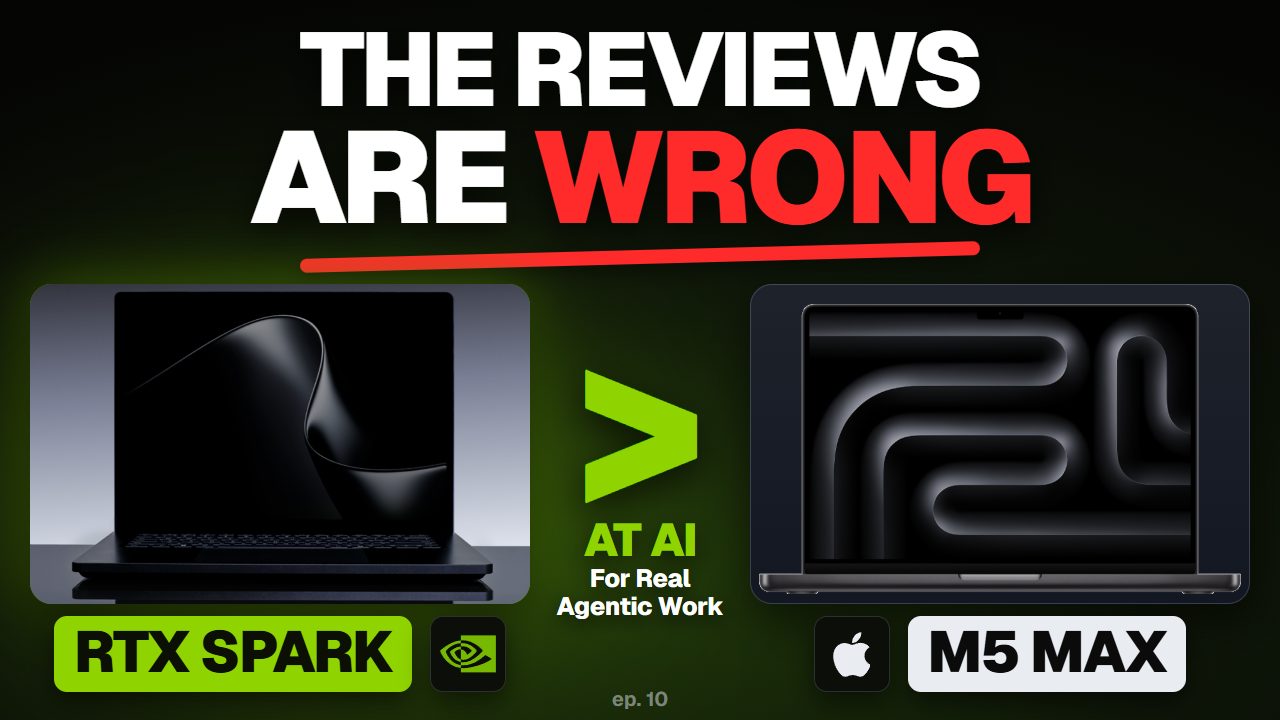 Plays here, from YouTube
Many of their charts measure the one thing a Mac does best and leave out the thing it does worst, which feels like a systematic bias to me.
Reading and writing
An AI model does two jobs. First it reads your prompt, which for an agent means the whole project so far, on every turn. Then it writes the answer.
Writing speed depends mostly on memory bandwidth, and Apple lists 614GB a second for the top M5 Max, against 273 for a DGX Spark. Reading depends on raw computing power, and that is where NVIDIA's chip is well ahead. Matthew Moniz put it simply: the RTX Spark laptops read faster, and the Macs write faster.
What the reviews measured
Hardware Canucks' review showed writing speed only, and for three of their six models the Mac ran MLX, Apple's own engine, while the Windows laptops ran standard files in LM Studio. Had they given the RTX Spark NVIDIA's own NVFP4 builds, as they gave the Mac MLX, it would at least have been like for like. To be fair, they told viewers the Mac was getting a boost.
Raid Owl added an M5 Max to his charts from figures he found online. Linus Tech Tips, who were careful, used an empty prompt, which they called a best case scenario themselves.
The agent test
Agents don't work with empty prompts. On Artificial Analysis's agent test, 168 turns of real work, Tom's Hardware measured the Surface RTX Spark laptop at 18.9 minutes and the M5 Max MacBook Pro at 24.74. By my own maths the Mac finished 5.84 minutes behind, with twice the memory bandwidth (Apple's 614 against up to 300GB a second for the RTX Spark laptops in the maker's specification, 2.05 times).
Hardware Canucks and Raid Owl are competent general tech reviewers, but I don't think they understand how to test AI, and their AI results are misleading. The best RTX Spark video I've seen is Alex Ziskind's, who tested the laptop against a DGX Spark on the same version of llama.cpp and said when his prompt was empty.
A few caveats
- The Mac really does write faster, and in a chat with short prompts the difference will probably show.
- Its battery life is a big win: Tom's Guide's battery test gave an M5 Pro MacBook Pro 21:25 in hours and minutes, against 10:15 for the RTX Spark laptop.
- The RTX Spark laptops are brand new, and Windows on ARM has come a long way in two years.
My own RTX Spark laptop with 128GB arrives next week, and an M5 Pro MacBook Pro with 64GB, the fairest match for its memory bandwidth, in late November.
What I would do
When my own RTX Spark laptop and M5 Pro MacBook Pro arrive, every test I do and every graph I show will name the engine, the file and the prompt length, the same rule I am holding everyone else to.
Read more
- Tom's Hardware's test of the Surface Laptop Ultratomshardware.com
- Artificial Analysis's results for laptops and workstationsartificialanalysis.ai
- Matthew Moniz's reviewyoutube.com
- Hardware Canucks' reviewyoutube.com
- Raid Owl's reviewyoutube.com
- LTT Labs, with how Linus Tech Tips testedlttlabs.com
- Alex Ziskind's RTX Spark videoyoutube.com
The numbers in this story
| Figure | What it is | From | Kind |
|---|---|---|---|
| 18.9 minutes | Surface Laptop Ultra on Artificial Analysis's agent test, measured by Tom's Hardware | tomshardware.com | a reviewer's test |
| 24.74 minutes | M5 Max MacBook Pro on the same test, measured by Tom's Hardware | see the story | a reviewer's test |
| 5.84 minutes | How far behind the Mac finished | 24.74 minus 18.9 | my own maths |
| 614 GB/s | The M5 Max's memory bandwidth, Apple's figure | apple.com | the maker's claim |
| 273 GB/s | A DGX Spark's memory bandwidth, the maker's figure | artificialanalysis.ai | the maker's claim |
If a number on this page is wrong, I would rather know. Tell me in the comments under the video and I will correct it here and pin the correction there. What has been corrected so far is on the corrections page.