Mac Studio M5 Ultra 512GB, and Apple's 3x cluster claim checked
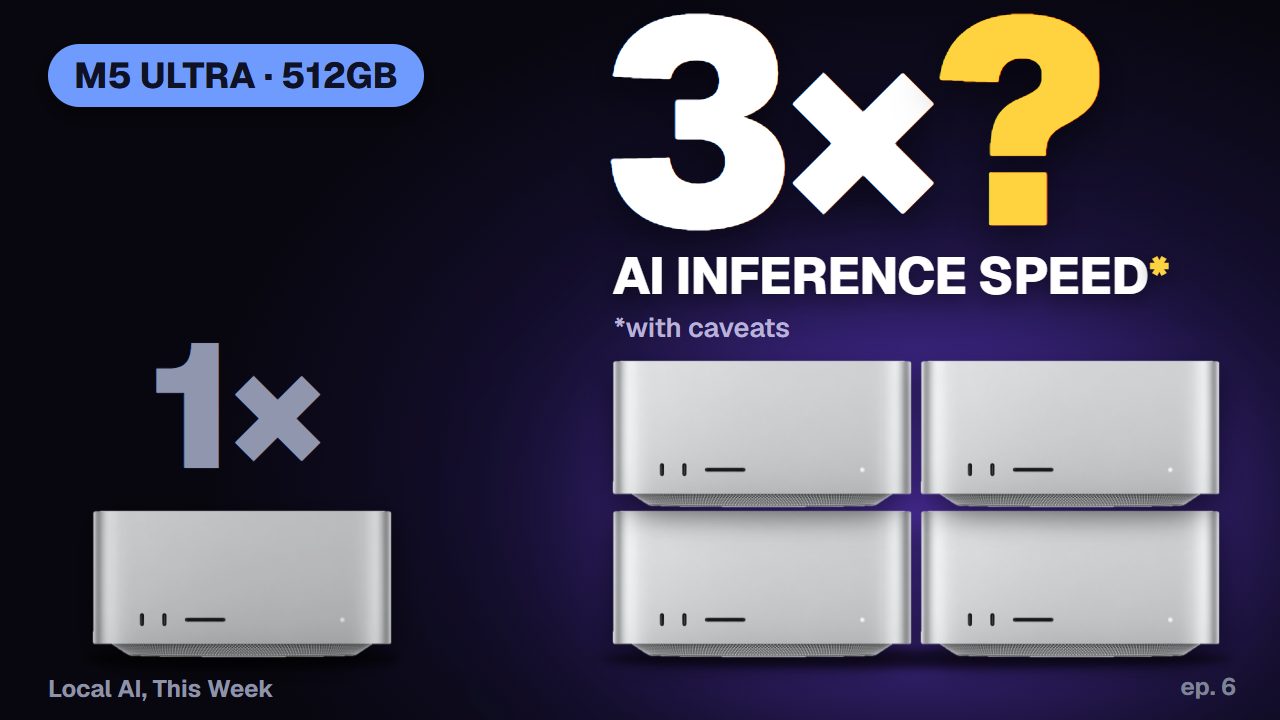
Apple says its latest Mac Studio can hold 512GB of memory in one box, the same as my whole cluster of four DGX Sparks, and that a cluster of Studios runs AI up to 3x faster than one. I looked up how Apple measured that, and I would wait for independent measurements before ordering.
 Plays here, from YouTube
Corrected on 3 October 2026. In the video of 28 September I said nobody had measured Apple's new Mac Studio. Somebody had, and their numbers are now set beside my own cluster's. I said so in M5 Ultra Mac Studio vs my four DGX Sparks: the same model.
Apple put the latest Mac Studio on sale on Tuesday 22 September. For those of us running models at home, the interesting one is the top version. Apple says its M5 Ultra chip can carry up to 512GB of unified memory, and that the memory moves at 1.2TB/s.
NVIDIA lists the DGX Spark at 273GB/s, so on the two makers' figures the Studio has 4.4 times the bandwidth (1,200GB/s divided by 273GB/s). As we know from the Sparks, memory bandwidth is what really decides how fast these machines write text.
The cluster claim
Apple says several Studios can now link up over Thunderbolt 5 and read each other's memory directly, and that a cluster runs AI up to 3x faster than a single Studio. According to Reuters, Apple showed four of them running Kimi K2.6, a 1 trillion parameter open model, all from a single wall socket.
My own four Sparks
This one is close to home for me. My own cluster is four DGX Sparks with 128GB each, so 512GB in total, the same as one of these Studios. The difference is that my memory sits in four separate boxes, which have to pass their work to each other over the network.
When I went from two Sparks to four with GLM 5.3 Flash, I measured the writing speed going from 46.9 to 68.5 tokens a second. That is 1.46 times the speed (68.5 divided by 46.9), well short of double.
How Apple measured it
So I looked up how Apple measured its 3x. The footnote on its Mac Studio page says it timed a summary of a 32K-token prompt, with a 72 billion parameter model, on four Studios against one. I think a job like that is mostly the machines reading the prompt, which spreads well across four boxes, and it says much less about how fast a cluster writes.
A few caveats
- Apple said the 512GB Studio would come in late October, and it gave no price for it.
- When I checked Apple's store on Sunday 27 September, any Studio with the full 36-core M5 Ultra chip was quoting 15 to 17 weeks, and the version with the smaller 30-core Ultra chip 6 to 7.
- The four Studio demonstration was Apple's own, and I could not find anyone independent who had measured one.
- A 1 trillion parameter model still needs more than one of these boxes, even at 4 bits. My own maths puts it at about 500GB before the cache.
- Four Studios would cost at least $21,996 (4 times $5,499, Apple's starting price for a Studio with the M5 Ultra), against about £10,000 for four Sparks, going by what OpenFaaS paid for theirs.
What I would do
I would wait for independent measurements before ordering anything with half a terabyte of memory in it.
Read more
- Apple's announcement of the Mac Studio with the M5 Ultraapple.com
- Apple's Mac Studio page, with the footnote on how the 3x was measuredapple.com
- Reuters on Apple's new Macs and the four Studio demonstrationreuters.com
- The Reddit thread that quotes Reuters on the demonstrationreddit.com
- NVIDIA's DGX Spark page, with its memory bandwidthnvidia.com
- The post on what OpenFaaS paid for four DGX Sparksblog.alexellis.io
The numbers in this story
| Figure | What it is | From | Kind |
|---|---|---|---|
| 512GB and 1.2TB/s | Memory and memory bandwidth of the M5 Ultra Mac Studio | apple.com | Apple's claim |
| 3 times | A cluster of Studios against a single Studio | apple.com | Apple's claim |
| A 32K-token prompt on a 72B model, 4 machines against 1 | How Apple measured that 3x, from its footnote | apple.com | the maker's claim |
| 46.9 to 68.5 tok/s, 1.46 times | GLM 5.3 Flash on two of my Sparks, then on four | My own DGX Sparks; 68.5 divided by 46.9 | measured by me |
| $21,996 | Four Studios at the starting price for the M5 Ultra | 4 times $5,499 | my own maths |
| about £10,000 | Four DGX Sparks, going by what OpenFaaS paid | blog.alexellis.io | an owner's report |
My Sparks would run a little faster than these figures. I cap their graphics chips at 2,200MHz, against about 2,400 uncapped, to cut their power use. When I tested the cap on one box in August, writing speed stayed within 1 per cent, reading was 2 to 4 per cent slower, and the chip's peak power fell from 55.5W to 43.3W.
If a number on this page is wrong, I would rather know. Tell me in the comments under the video and I will correct it here and pin the correction there. What has been corrected so far is on the corrections page.