Two DGX Sparks or a Mac Studio Ultra: the same 256GB, the numbers side by side
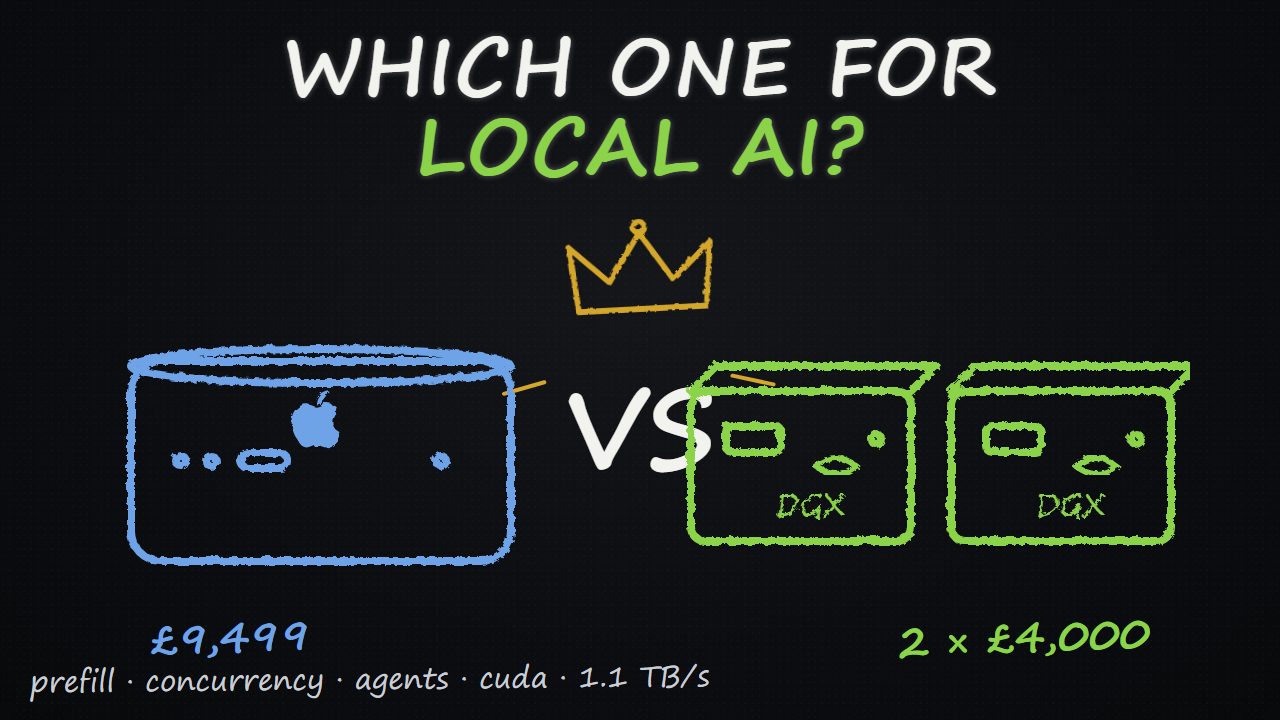
A buyer with two new DGX Sparks asked on Reddit whether to send them back now that Apple had announced the M5 Ultra Mac Studio. I put my own cluster's numbers next to what Mac Studio owners measure, and I think the answer depends on the work: short questions suit the Mac, and agents and long documents suit the Sparks.
 Plays here, from YouTube
Someone on Reddit had just posted the question I had been asking myself. He had bought two NVIDIA DGX Sparks, then Apple announced the new Mac Studio Ultra, and he was wondering whether to send them back.
I put real numbers side by side: months of real work on my own Spark cluster, against what Mac Studio owners measure.
What each one holds
The Mac Studio keeps all of its memory in one aluminium block. The DGX Spark is a box the size of a hardback book with 128GB, meant to be chained to others. Two Sparks are 256GB, the same as the mid-spec Mac, and four are 512GB, the same as its top option.
Memory bandwidth sets the ceiling on speed. NVIDIA's figure for one Spark is 273 GB/s. For the M3 Ultra Mac Studio, Apple says over 800 GB/s and Macworld's table gives 819. Macworld reported 1.2TB/s for the M5 Ultra, about 50 per cent more.
Two Sparks are often quoted at 546 GB/s and four at 1,092, but the boxes do not become one pool of fast memory. With two, each box reads its own half of the model at 273 GB/s, and after every layer they swap results over a 200-gigabit link, which is 25 GB/s, about a tenth of local memory speed. Going from two boxes to four measured one and a half times faster on my cluster, not twice.
What they cost
When I priced them, two Sparks were about £8,000 and a Mac Studio configured to the same 256GB was £9,499 on Apple's own configurator. The Sparks could be bought straight away, one box first and more later.
Four Sparks with their network switch were £15,000 to £16,000. Apple removed the Mac's 512GB option in March, and it was due back with the M5 Ultra in late October at a price Apple had not announced. It was expected to come in at up to £20,000 with the base 1TB of storage.
Apple had already raised the Mac Studio's price twice in 2026, and Macworld gave the M5 Ultra's base price as £5,499.
How fast they are
I compared the same model on both, Qwen 3.8 27B at 4-bit, which needs about 14GB read for every token. I put the ceiling for two Sparks at roughly 40 tokens a second, and they measure nearly 43 because speculative decoding gets extra tokens out of every read. The Mac's ceiling is comfortably above that, and when the model first came out an M3 Ultra owner reported 14.0. As the recipes matured, the same machine climbed to 40 and 50, so I think the software was holding it back at 14.
Reading the prompt before answering is what agents, long documents and coding assistants depend on. My two Sparks read a 150,000-token document in 50 seconds, which is over 3,000 tokens a second. At the 93.1 tokens a second the same owner reported for prompt reading, that document takes an M3 Mac Studio 27 minutes by my own maths. Apple's own claim for the M5 Ultra was prompt reading up to four times faster. Giving Apple the four times in full, about 370 tokens a second, the document would still take nearly 7 minutes.
The Spark runs vLLM, which is a server, and macOS and its tools are built around one model and one user. My two Sparks ran Qwen 3.8 27B for the whole household: eight agents at once, each with its full 264,000-token context, at 38 to 40 tokens a second each and over 300 together. One benchmarking team sent 256 parallel requests to a single Spark and measured 695 tokens a second in aggregate.
The 2.7 tokens a second often quoted for the Spark came from the LMSYS review in October 2025, the Spark's launch week, with Llama 3.1 70B at FP8 and day-one software. Since then a reviewer has measured 33.5 tokens a second from gpt-oss-120B on one Spark.
What was not yet known
- I had not tested an M5 Ultra. It was announced on 25 August and was due to ship on 22 September.
- Apple's four times came from Apple's own test with Apple's own tool, measured as time to first token.
- The next Spark generation was already rumoured to have double the bandwidth.
What I would do
I would buy the Mac Studio for one big model, short prompts and a silent desk, and the DGX Sparks for agents, long documents and several people or jobs at once. I would buy for the work I have this month and not for the headline in October.
The numbers in this story
| Figure | What it is | From | Kind |
|---|---|---|---|
| 273 GB/s | One DGX Spark's memory bandwidth | see the story | the maker's claim |
| 819 GB/s | The M3 Ultra Mac Studio's memory bandwidth | see the story | the maker's claim |
| £5,499 and 1.2TB/s | The M5 Ultra's base price and memory bandwidth | see the story | reported |
| 14.0 and 93.1 tok/s | Writing and prompt reading, Qwen 3.8 27B on a 256GB M3 Ultra | see the story | an owner's report |
| 695 tok/s | One DGX Spark answering 256 requests at once | see the story | a reviewer's test |
| 2.7 tok/s | Llama 3.1 70B on one DGX Spark in its launch week | see the story | independent score |
My Sparks would run a little faster than these figures. I cap their graphics chips at 2,200MHz, against about 2,400 uncapped, to cut their power use. When I tested the cap on one box in August, writing speed stayed within 1 per cent, reading was 2 to 4 per cent slower, and the chip's peak power fell from 55.5W to 43.3W.
If a number on this page is wrong, I would rather know. Tell me in the comments under the video and I will correct it here and pin the correction there. What has been corrected so far is on the corrections page.