DeepSeek V4.1 Flash on 4 DGX Sparks: the 552B open model
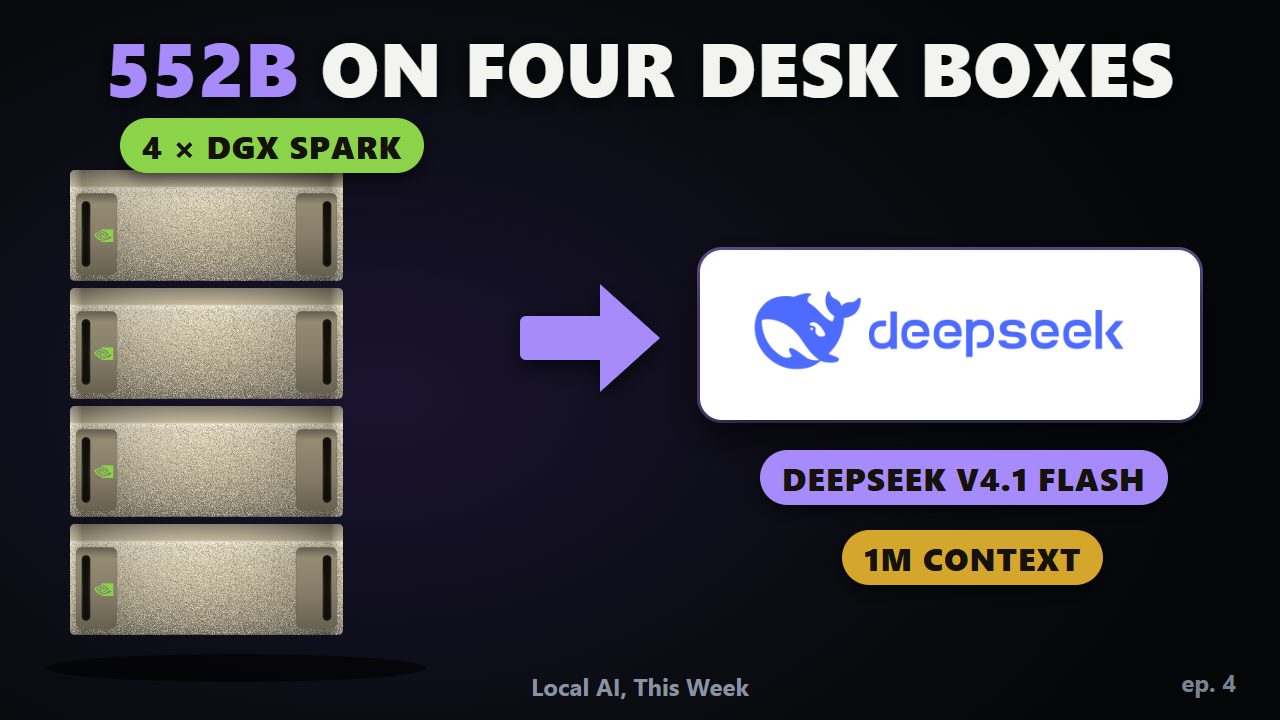
DeepSeek released a 552 billion parameter model with open weights on 10 September, and within a day an owner had it running on four DGX Sparks. The speeds were similar to GLM 5.3 Flash on my own four, but they came from one owner's first day on a four bit build that had not been checked for quality, as far as I could see.
 Plays here, from YouTube
On 10 September, DeepSeek released DeepSeek V4.1 Flash, with open weights under the MIT licence. It is a much bigger model than the V4 Flash I ran on two of my DGX Sparks in July and August. DeepSeek's model card gives it 552 billion parameters in its main network, plus a lookup table of another 196 billion that DeepSeek calls Engram memory, and says it reads images as well as text.
How little of it runs at once
What matters if you run models at home is how little of that it uses at once. DeepSeek says only 16 billion parameters are active for each token it writes, and that a long conversation costs 890 bytes of memory per token. By my own maths, a full one million token window takes 0.89GB (890 bytes times 1,000,000 tokens).
The scores
DeepSeek's own benchmarks put it level with the best closed models on some coding agent tests, although it falls well behind them on the hardest one. On Artificial Analysis's independent index it scored 40 on 11 September. That was 5 points up on the old V4 Flash, level with Qwen 3.8 Flash Next, and 2 points behind GLM 5.3 Flash.
| Model | Artificial Analysis index |
|---|---|
| GLM 5.3 Flash | 42 |
| DeepSeek V4.1 Flash | 40 |
| Qwen 3.8 Flash Next | 40 |
| DeepSeek V4 Flash | 35 |
Artificial Analysis's open-weights leaderboard, read on 11 September 2026. Artificial Analysis had updated its index since the week before, from version 4.2 to 4.3, so every score sits lower than the ones I quoted then.
The speeds on four DGX Sparks
Within a day, an owner on NVIDIA's developer forum had it running on four DGX Sparks. They kept the Engram tables, 203GB of them, on the SSD, so the main network fitted in the four boxes' memory. They reported 52 tokens a second on code in their benchmark and 23 on prose, for one user. A second owner posted 69.24 on code and 44.24 on prose the next day.
I measured GLM 5.3 Flash on my four Sparks on Friday 11 September at 61.8 tokens a second on code and 29.0 on prose. So a model with far more parameters ran at a similar speed, because it uses fewer of them for each token (16 billion against the 18 billion NVIDIA lists for GLM 5.3 Flash).
A few caveats
- The first owner's numbers came from their first day, on a four bit build that had not been checked for quality, as far as I could see. The recipe was still changing while I read it.
- Their speed went from 5 tokens a second to 41 once CUDA graphs and DeepSeek's own speculative decoding were on. It peaked at 77 after they found two GPUs stuck below 1 GHz, which only unplugging the box would clear.
- With the tables on disk, the main network was about 307GB by my own maths (510.3GB of files minus about 203GB of tables), so a single Spark, a 128GB Mac or a pair of graphics cards would not hold it.
- LM Studio and Ollama only offered it through their cloud services, and llama.cpp could not run it yet.
What I would do
For now my four DGX Sparks stay on GLM 5.3 Flash, and I will run DeepSeek V4.1 Flash myself once the recipes settle.
Read more
- DeepSeek's announcement of V4.1 Flashdeepseek.com
- DeepSeek's model card on Hugging Face, with the parameter counts and its own benchmarkshuggingface.co
- The first owner's thread on NVIDIA's developer forum, with the recipe and the speedsforums.developer.nvidia.com
- The second owner's speeds on NVIDIA's developer forumforums.developer.nvidia.com
- Artificial Analysis, open-weights leaderboardartificialanalysis.ai
- NVIDIA's model card for its GLM 5.3 Flash build, with the active parameter counthuggingface.co
- Ollama's page for the model, which listed a cloud version onlyollama.com
- The llama.cpp pull request, which could convert the model but not load itgithub.com
The numbers in this story
| Figure | What it is | From | Kind |
|---|---|---|---|
| 552B and 196B | Parameters in the main network, plus the Engram lookup table | huggingface.co | DeepSeek's model card |
| 40, 35, 40 and 42 | DeepSeek V4.1 Flash, V4 Flash, Qwen 3.8 Flash Next and GLM 5.3 Flash on the index | artificialanalysis.ai | Artificial Analysis's score |
| 52 and 23 tok/s | The first owner on four DGX Sparks, code and prose | forums.developer.nvidia.com | an owner's report |
| 69.24 and 44.24 tok/s | A second owner on four DGX Sparks, code and prose | forums.developer.nvidia.com | an owner's report |
| 61.8 and 29.0 tok/s | GLM 5.3 Flash on my own four DGX Sparks, code and prose | my own test | measured by me |
| 0.89GB | Memory for a full 1,000,000 token window | 890 bytes times 1,000,000 tokens | my own maths |
My Sparks would run a little faster than these figures. I cap their graphics chips at 2,200MHz, against about 2,400 uncapped, to cut their power use. When I tested the cap on one box in August, writing speed stayed within 1 per cent, reading was 2 to 4 per cent slower, and the chip's peak power fell from 55.5W to 43.3W.
If a number on this page is wrong, I would rather know. Tell me in the comments under the video and I will correct it here and pin the correction there. What has been corrected so far is on the corrections page.